
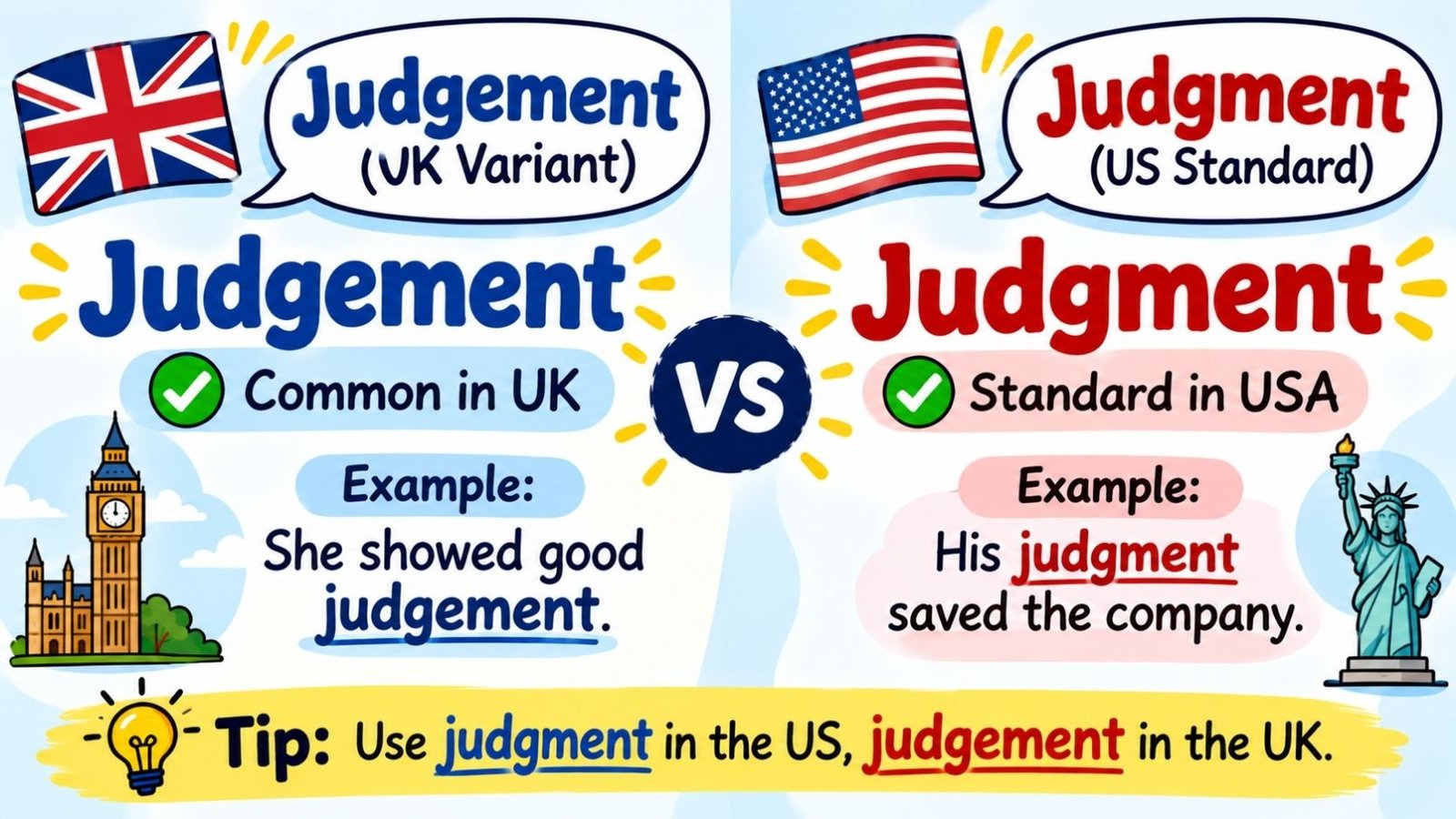
Both spellings are correct, but they are not equal everywhere. In American English, judgment is the standard spelling, and in the USA it is the one you should use. Judgement is a common variant in British English and other regions that follow UK spelling habits.
The word means the ability to make sound decisions, an opinion formed after thought, or a court’s official decision. Many readers see both spellings online and wonder if one is a typo. It is not. The choice depends mostly on your audience, your style guide, and whether you are writing about law.
Quick Answer: Judgement Or Judgment?
| Spelling | Where it is standard | Notes |
| Judgment | USA, Canada (often), and legal writing in the UK | The preferred form in American dictionaries and AP style |
| Judgement | UK, Australia, New Zealand, India (often) | Common in everyday British writing |
💡 Tip: If you are writing for a US audience, use judgment every time. Pick one spelling and keep it consistent through the whole piece.
What Does Judgment Mean?
Judgment is a noun. It has several related meanings, and context tells you which one is intended.
Meaning 1: Good sense or wisdom. This is the ability to weigh facts and make a smart choice. Example: “She showed good judgment when she waited to sign the contract.”
Meaning 2: An opinion or conclusion. This is a view formed after thinking about something. Example: “I’ll reserve judgment until I hear both sides.”
Meaning 3: A legal decision. This is the official decision of a court. Example: “The court entered judgment for the plaintiff.”
Meaning 4: Divine or final judgment. In religious contexts, this refers to God’s final assessment of people. Example: “Many traditions teach about a day of final judgment.”
Meaning 5: Criticism or condemnation. This is a negative view of someone’s behavior. Example: “I felt no judgment from my friends.”
In Hindi, the closest equivalents are निर्णय (nirnay) for a decision and फ़ैसला (faisla) for a ruling.
Why Are There Two Spellings?
The word comes from the verb judge. When you add the ending ment, you can either keep the silent e or drop it. British English tends to keep it, and American English tends to drop it.
Each side has a logic. Keeping the e shows the link to the base word judge. Dropping the e follows a pattern Americans often prefer, as with acknowledgment, which US writers often spell without the middle e.
Both forms have been in use for centuries. Neither is a modern invention or a mistake.
Judgment Vs Judgement By Country
Here is how usage generally works.
- United States: Judgment is standard. Dictionaries list it first, and AP style requires it.
- United Kingdom: Both are accepted. Judgement is common in general writing. In legal writing, judgment is often used for court decisions.
- Canada: Both appear, and judgment is very common, especially in legal contexts.
- Australia and New Zealand: Judgement is common in general writing, and judgment is common in law.
- India: Usage is mixed. Courts and legal documents often use judgment, while everyday writing often uses judgement.
⚠️ Note: Sources differ on how strict these preferences are. Always check the style guide of the publication or institution you are writing for.
Judgement Or Judgment In Legal Writing
In law, judgment is the safest spelling in almost every English speaking country. A judgment is the final decision of a court that resolves the dispute between the parties.
Common legal terms include:
- Summary judgment: A decision made by a judge without a full trial, because the key facts are not in real dispute. In US federal courts, this is governed by Rule 56 of the Federal Rules of Civil Procedure.
- Motion for summary judgment: A formal request asking the court to decide the case, or part of it, without a trial.
- Default judgment: A decision entered when one side fails to respond or appear. In federal court, this is covered by Rule 55.
- Judgment debtor: The person who owes money under a court judgment.
- Judgment creditor: The person who is owed money under a court judgment.
- Judgment reversed: An appeals court has overturned the lower court’s decision.
Judgment Vs Verdict
These two words are often confused. A verdict is the finding of a jury, such as guilty or not guilty. A judgment is the court’s official decision, which often follows the verdict and makes it enforceable.
Judgment Call Or Judgement Call
A judgment call is a decision that has no clear right answer. You must rely on your own sense and experience.
Example: “Whether to postpone the launch was a tough judgment call.”
In the USA, write judgment call. The same rule applies to related phrases like poor judgment, error in judgment, clouded judgment, and lack of judgment.
Judgment Day Or Judgement Day
Judgment Day refers to a final reckoning, when people are judged for their actions. The idea appears in Christianity, Islam, and Judaism, each with its own beliefs and terms.
For US readers, Judgment Day is the usual spelling. You will also see it in popular culture. Some well known titles and names include:
- Terminator 2: Judgment Day, the 1991 film directed by James Cameron.
- Judgment Day, a wrestling event name used by WWE.
- Judgment Night, a 1993 thriller film.
- Hellraiser: Judgment, a 2018 horror film in the Hellraiser series.
- Judgment at Nuremberg, a 1961 film directed by Stanley Kramer about the post-war Nazi trials.
- The Last Judgment, Michelangelo’s fresco in the Sistine Chapel, painted between 1536 and 1541.
When Is Judgment Day?
No one can say. Religious teachings do not give a date, and the Gospel of Matthew states that no one knows the day or the hour. Many predicted dates, including those made by preacher Harold Camping for 2011, passed without incident.
Judgement Tarot Card
In tarot, the card is commonly printed as Judgement with the e. It is card number XX in the Major Arcana. The classic Rider Waite deck uses this spelling.
The card usually shows an angel blowing a trumpet while people rise from their graves. Readers generally connect it with awakening, reflection, and a call to change.
- Upright meaning: Self evaluation, renewal, forgiveness, and answering a calling.
- Reversed meaning: Self doubt, avoiding reflection, or harsh self criticism.
💡 Tip: Tarot meanings vary by reader and by deck. These are common interpretations, not fixed rules.
How to Pronounce Judgment
Both spellings are pronounced the same way.
- IPA (American): /ˈdʒʌdʒmənt/
- Simple guide: JUJ ment
- Syllables: Two syllables, with stress on the first.
The silent e in judgement does not change the sound.
Part Of Speech And Word Forms
Judgment is a noun. It can be countable or uncountable, depending on meaning.
| Form | Example |
| Singular | “He made a quick judgment.” |
| Plural | “Judges issued several judgments this term.” |
| Uncountable | “She has good judgment.” |
| Adjective | “Judgmental” (US) or “judgemental” (UK) |
| Related noun | “Misjudgment” or “misjudgement” |
| Related verb | “Judge” |
The adjective judgmental describes someone who criticizes others too quickly. The same spelling choice applies: judgmental in the USA, judgemental in the UK.
Origin Of The Word Judgment
The word entered English from Old French jugement, which came from the verb jugier, meaning to judge. That verb goes back to the Latin iudicare, meaning to give a judgment. English speakers used the word in the Middle Ages for both legal decisions and personal opinions.
The two spellings developed because writers disagreed on whether to keep the e from the verb judge. Over time, American usage settled on dropping it.
Synonyms And Related Words
| Word | Meaning | Difference |
| Discernment | The ability to see things clearly | More about perception than decision |
| Wisdom | Deep understanding and good sense | Broader and more general |
| Assessment | An evaluation of something | More formal and analytical |
| Verdict | A jury’s finding in a trial | Specific to legal juries |
| Ruling | A formal decision by a judge | Often narrower than a final judgment |
| Opinion | A personal view | Does not require careful evaluation |
| Common sense | Practical, everyday good sense | More informal |
Common Mistakes
Mixing spellings in one document.
❌ Incorrect: “Her judgment was sound, but his judgement was poor.”
✅ Correct: “Her judgment was sound, but his judgment was poor.”
Pick one spelling and keep it throughout.
Using judgement in a US legal document.
❌ Incorrect: “The court entered summary judgement.”
✅ Correct: “The court entered summary judgment.”
US courts and legal publishers use judgment.
Spelling it “judgement” in an AP style article.
AP style prefers judgment, so a US newsroom would change it.
Frequently Asked Questions
Is it judgement or judgment?
Both are correct. Judgment is standard in American English, and judgement is common in British English.
Which spelling do dictionaries prefer?
American dictionaries list judgment first. Oxford sources note that both spellings are used in British English, with judgement being common there.
Is judgment a noun or a verb?
It is a noun. The related verb is judge.
How do you spell it in legal writing?
Use judgment. This is the dominant form in US, Canadian, and many UK legal texts.
What is a summary judgment?
It is a court decision made without a full trial, when there is no real dispute about the key facts and one side is entitled to win under the law.
Is judgement wrong in the USA?
It is not wrong, but it looks unusual to American readers. Editors in the USA will usually change it.
What does judgment mean in a sentence?
“His judgment saved the company from a costly mistake.” Here it means good sense in making decisions.
How do you pronounce judgment?
Say JUJ ment, with stress on the first syllable.
Conclusion
Judgement and judgment are two accepted spellings of the same word. Judgment is the standard in American English and in most legal writing. Judgement is common in everyday British, Australian, and Indian English.
If you write for a US audience, choose judgment and use it consistently, including in phrases like judgment call, summary judgment, and Judgment Day. Use judgement only when you are following UK style, quoting a title that uses it, or writing about the tarot card as it is traditionally printed.

Siddharth Rao is a dedicated writer and researcher at Gram Nexo, specializing in English grammar, vocabulary, word differences, meanings, and language usage. With a focus on accuracy, clarity, and practical learning, they create informative content that helps readers understand complex language concepts, avoid common mistakes, and communicate more confidently in everyday English.
One Comment