
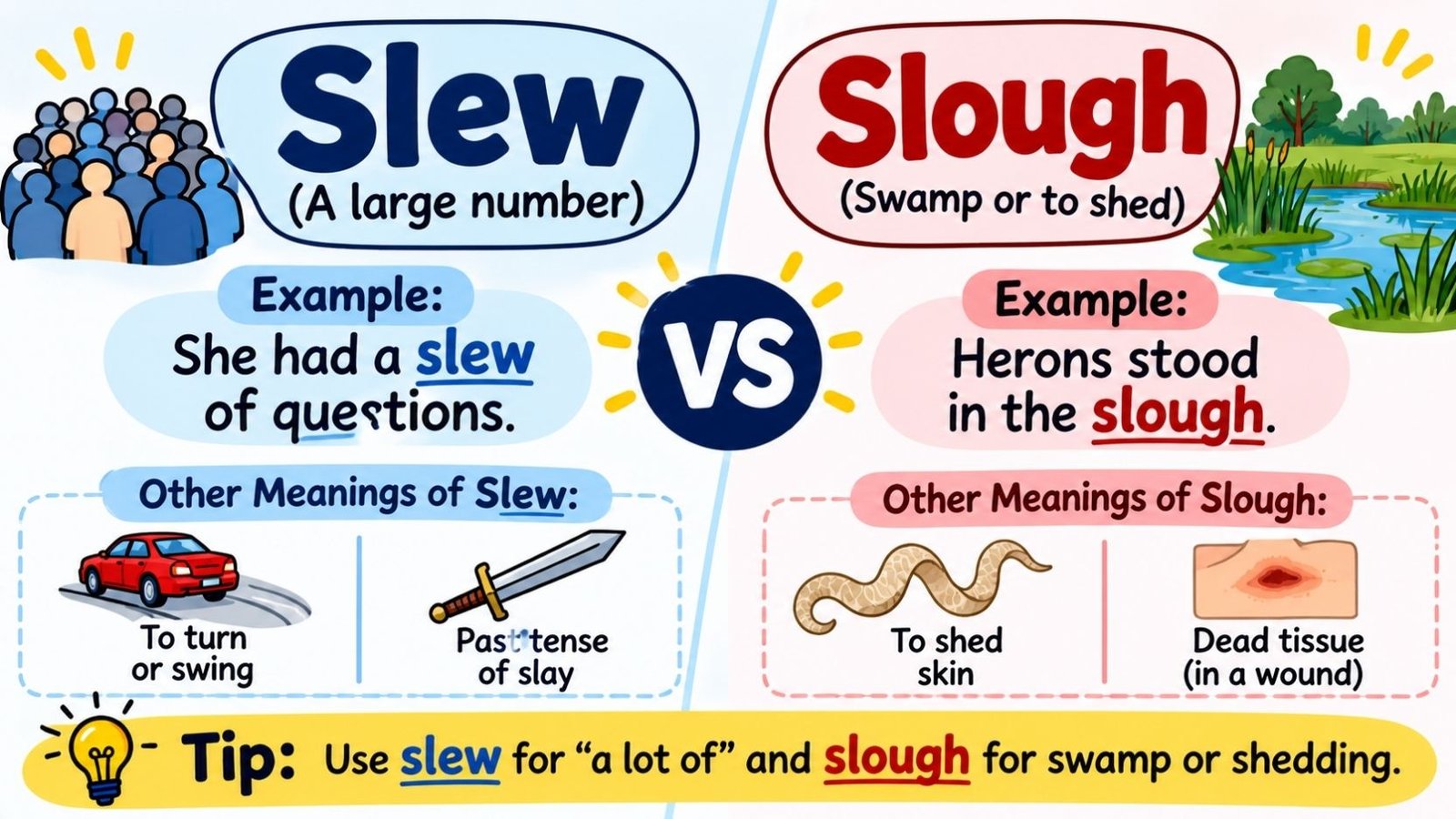
Slew and slough are two different words. Slew usually means a large number of something, as in “a slew of emails.” Slough can mean a swampy place, the act of shedding something, or dead tissue in a wound. They sound alike only in one of slough’s pronunciations, and they are not interchangeable.
People mix them up because the spelling looks odd and the sounds overlap. Some say “a whole slough of questions” when they mean “a whole slew of questions.” The first is a mistake in standard English. This guide explains each meaning, pronunciation, origin, and common error, so you can use both words with confidence.
Quick Answer: Slew vs Slough
| Word | Main meaning | Part of speech | Example |
| Slew | A large number or amount | Noun | She had a slew of questions. |
| Slew | To turn or swing around | Verb | The truck slewed across the road. |
| Slew | Past tense of “slay” | Verb | The knight slew the dragon. |
| Slough | A swamp, marsh, or muddy inlet | Noun | Herons stood in the slough. |
| Slough | To shed or cast off | Verb | Snakes slough their skin. |
| Slough | Dead tissue, such as in a wound | Noun | The nurse noted slough on the wound bed. |
💡 Tip: If you mean “a lot of,” use slew. Slough is never correct for that meaning.
What Does Slew Mean?
Slew has three separate meanings. They are not related to each other, so it helps to learn them one at a time.
Meaning 1: A large number
In this sense, slew is an informal noun. It means a big group or a large quantity. It is mostly American in feel and common in everyday speech.
- I have a slew of questions about the contract.
- The festival offers a slew of events this weekend.
You will usually see it as “a slew of” followed by a plural noun. “A whole slew of” is also common and adds emphasis.
Meaning 2: To turn or swing around
As a verb, slew means to twist, pivot, or skid sideways. It often describes vehicles, cranes, or heavy objects. The spelling “slue” is a common variant.
- The car slewed on the icy road.
- The crane operator slewed the boom to the left.
Meaning 3: Past tense of slay
Slew is also the past tense of the verb slay. This is a completely different word that happens to share the spelling.
- The hero slew the monster.
The forms are slay, slew, slain. Note that “slayed” is used in modern slang, as in “she slayed that performance,” but “slew” is the traditional past tense for killing.
What Does Slough Mean?
Slough has more than one pronunciation, and the meaning changes with the sound. That is the main reason people get confused.
Meaning 1: A swamp, marsh, or muddy inlet
A slough is a low, wet place. It may be a slow channel, a backwater, or a stretch of marshland. This meaning is common in American geography.
- Egrets fed along the edge of the slough.
Real places use this word. Elkhorn Slough is a tidal estuary in Monterey Bay, California. Six Mile Cypress Slough Preserve is a nature area in Fort Myers, Florida. Slough Creek Campground is in Yellowstone National Park.
Meaning 2: To shed or cast off
As a verb, slough means to drop or shed something, often a layer. It appears in the phrase “slough off.”
- The snake began to slough its old skin.
- She tried to slough off the criticism.
As a noun, it can also mean the skin a snake has shed.
Meaning 3: Dead tissue in a wound
In medicine, slough is soft, moist, dead tissue on a wound surface. It is often yellow, tan, white, or greenish and may look stringy. It is made of dead cells and fluid.
Meaning 4: A town in England
Slough is also a town in Berkshire, England. It is a proper noun there, and its name is pronounced to rhyme with “cow.” This is why searches for Slough often show hotels, businesses, and local services.
How to Pronounce Slew and Slough
Slew has one pronunciation. Slough has three, depending on meaning.
| Word | Meaning | Rhymes with | Common spelling aid |
| Slew | All meanings | Blue, new | sloo |
| Slough | Swamp or marsh | Blue, or cow | sloo or slau |
| Slough | Shed skin or dead tissue | Stuff | sluff |
| Slough | Town in England | Cow | slau |
For the swamp meaning, major American dictionaries list both “sloo” and “slau.” The “sloo” version sounds just like slew, which is where the confusion begins. For shedding skin or wound tissue, the sound is “sluff.”
⚠️ Common mistake: Do not assume the spelling tells you the sound. Context decides which pronunciation fits.
Where Do The Words Come From?
Origin Of slew
Slew meaning “a large number” is generally traced to the Irish word “sluagh,” meaning a crowd or host. It entered American English in the early 1800s. The turning sense, also spelled slue, is a nautical term whose exact origin is uncertain. The past tense of slay comes from Old English.
Origin Of slough
The swamp meaning comes from Old English “sloh,” a muddy place. The shedding meaning is a separate word that appears later in Middle English. Dictionaries treat them as different words that happen to share one spelling.
Slew Vs Slough In Wound Care
Many readers search for slough because of a wound. This section gives general information only. It is not medical advice, and a clinician should assess any wound.
What is wound slough?
Slough is dead tissue on the wound bed. It is usually soft and moist. It can be yellow, tan, white, or greenish.
Is wound slough good or bad?
It is generally a sign that the wound is not healing cleanly. Slough can block new tissue from growing. Clinicians often remove it, a process called debridement, so healing can continue.
Is wound slough normal?
It is common in some wounds, but it is not something to ignore. If you see yellow or stringy material in a wound, ask a healthcare professional to look at it.
Slough vs eschar vs scab
| Term | Texture | Color | What it is |
| Slough | Soft, moist, sometimes stringy | Yellow, tan, white, green | Dead tissue with fluid |
| Eschar | Dry, hard, leathery | Black or brown | Dead tissue that has dried |
| Scab | Dry crust | Reddish brown | Dried blood that protects a healing wound |
A scab is a normal part of healing in many minor wounds. Slough and eschar are dead tissue, and clinicians usually track them closely.
Slew Foot Meaning
Slew foot has two uses, and neither involves slough.
- In hockey: A slew foot is an illegal move in which a player uses a leg or foot to knock an opponent’s feet out from under them. It can cause a hard fall, so it is penalized severely. Under NHL rules, it is generally treated as a major penalty with a game misconduct.
- In everyday speech: “Slew footed” or “slewfooted” can describe someone whose feet turn outward.
“Slough foot” is not a recognized phrase. If you see it, it is a misspelling of slew foot.
Slew Rate
In electronics, slew rate is the fastest speed at which an output signal can change. It is usually measured in volts per microsecond. Engineers use it to describe amplifiers and similar circuits. The word here ties back to the “turning” sense of slew, meaning a swing or change.
Seattle Slew And The Name Slew
Seattle Slew was an American Thoroughbred racehorse. He won the Triple Crown in 1977 and was undefeated when he did it. Billy Turner trained him. His name is commonly explained as a mix of Seattle and “slew,” a variant spelling of slough in its swampy meaning. So here, the horse’s name is a nice example of how these words can overlap.
Slew Vs Skew
These two are also easy to confuse, but they are unrelated in meaning.
| Word | Meaning | Example |
| Slew | A large number, or to swing around | A slew of problems appeared. |
| Skew | To slant or distort | The poll results were skewed. |
Skew is about bias or angle. Slew is about quantity or movement.
Slew Meaning in Urdu And Sindhi
For “a slew of,” the closest Urdu meanings are “ڈھیر سارے” (dher saare) or “بہت سارے” (bohat saare). Both mean “a lot of” or “plenty of.” In Sindhi, “گھڻا” (ghanna) carries the same idea of “many.” For the verb meaning “to turn,” Urdu speakers might say “گھومنا” (ghoomna), though context matters.
Common Mistakes With Slew And Slough
❌ Incorrect: She received a slough of invitations.
✅ Correct: She received a slew of invitations.
Why: Only slew means a large number.
❌ Incorrect: The hero sloughed the dragon.
✅ Correct: The hero slew the dragon.
Why: Slough means to shed. Slew is the past tense of slay.
❌ Incorrect: The wound has slew on it.
✅ Correct: The wound has slough on it.
Why: Slough is the medical term for dead tissue.
❌ Incorrect: He tried to slew off his worries.
✅ Correct: He tried to slough off his worries.
Why: “Slough off” means to get rid of something.
Synonyms And Related Words
- For slew (a large number): lot, bunch, heap, load, host, raft, flood.
- For slough (a swamp): marsh, bog, swamp, mire, backwater.
- For slough (to shed): shed, discard, cast off, drop.
Slew is more casual than “numerous” or “a great many.” It works well in conversation and informal writing. In formal writing, “a large number of” is safer.
Frequently Asked Questions
What is the difference between slew and slough?
Slew means a large number, to turn, or the past tense of slay. Slough means a swamp, to shed, or dead tissue.
Is it “a whole slew” or “a whole slough”?
It is “a whole slew.” Slough does not mean “a lot.”
How do you pronounce slough?
It depends on the meaning. A swamp is “sloo” or “slau.” Shedding skin or wound tissue is “sluff.” The English town rhymes with “cow.”
Is slew a noun or a verb?
Both. It is a noun in “a slew of questions” and a verb in “the car slewed.”
Is “slue” the same as “slew”?
For the meaning “to turn,” yes. Slue is a variant spelling. For “a large number,” slew is the standard form.
What does slew of questions mean?
It means many questions. For example, “I have a slew of questions” means you have a lot to ask.
Is wound slough good or bad?
It is dead tissue and usually needs attention. A healthcare professional can tell you how to treat it.
What is the difference between slough and a scab?
A scab is a dry crust of dried blood. Slough is soft, moist dead tissue.
Conclusion
Slew and slough are different words with different jobs. Slew means a large number, to swing around, or the past tense of slay. Slough means a swamp, to shed, or dead tissue in a wound. Their spelling and sound overlap only in part, so context matters.
The easiest rule is this: use slew for “a lot,” and slough for wet ground, shedding, or wound tissue. If you hear “sluff,” think of shedding. If you ever write “a slough of questions,” switch it to slew.

Siddharth Rao is a dedicated writer and researcher at Gram Nexo, specializing in English grammar, vocabulary, word differences, meanings, and language usage. With a focus on accuracy, clarity, and practical learning, they create informative content that helps readers understand complex language concepts, avoid common mistakes, and communicate more confidently in everyday English.