
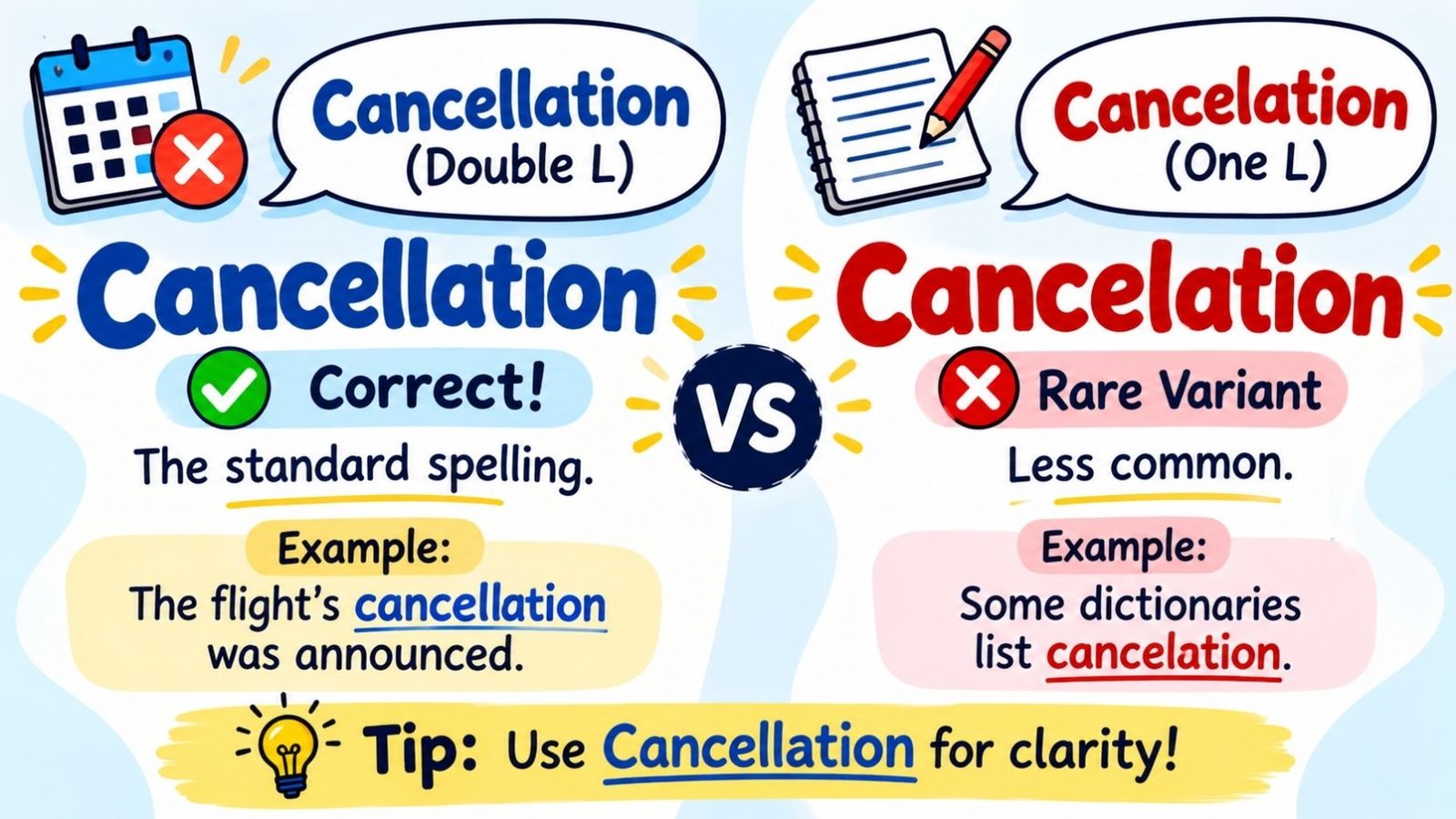
Cancellation is the correct and standard spelling in American English. It has a double L, and it is the form used by AP style, major dictionaries, airlines, hotels, and government agencies. Cancelation, with one L, is a less common variant that some US dictionaries list as acceptable.
The confusion comes from the verb. Americans usually write “canceled” with one L, so many people assume the noun should also have one L. It does not. The noun keeps both Ls even when the verb loses one, so the safest choice is almost always cancellation.
Quick Answer
| Spelling | Status in US English | Should you use it? |
| Cancellation | Standard and most common | Yes, in almost every situation |
| Cancelation | Rare variant, listed by some dictionaries | Only if a style guide or brand requires it |
💡 Tip: If you are unsure, write cancellation. No reader will think it is wrong, and no editor will correct it.
What Does Cancellation Mean?
Cancellation is a noun. It means the act of ending, calling off, or canceling something that was planned, scheduled, or agreed.
Meaning 1: Calling off an event or service. A flight, concert, meeting, or class is stopped before it happens.
Meaning 2: Ending an agreement or subscription. A gym membership, insurance policy, or streaming plan is ended.
Meaning 3: Cancelling out an effect. Two things offset each other. This is the meaning in “noise cancellation,” where sound waves are used to reduce unwanted noise.
Meaning 4: Legal or official voidance. A court or agency declares something no longer valid. In US immigration law, the formal term is “cancellation of removal.”
Is Cancelation Ever Correct?
Yes, but rarely. Merriam-Webster lists cancelation as a variant of cancellation. Some writers use it because it matches the one L in “canceled.”
The problem is that it looks like a typo to many readers. Search results, legal forms, airline policies, and news headlines overwhelmingly use the double L. Writing cancelation can make your text look careless, even though it is not strictly wrong.
Why Do People Get Confused?
The confusion starts with the verb. American English prefers one L when adding endings to cancel. British English keeps two.
| Word | American English | British English |
| Past tense | canceled | cancelled |
| Present participle | canceling | cancelling |
| Noun | cancellation | cancellation |
Notice the last row. The noun is spelled the same in both varieties. That is why cancellation is the safest spelling anywhere in the world.
The reason is simple. Most American spelling reforms apply to verb endings, such as traveled and modeled. The noun cancellation was formed differently, and it stayed as it was.
Canceled Or Cancelled?
This is a related question, and readers often search for it together.
- Canceled is the preferred American spelling.
- Cancelled is the preferred British spelling.
- Both are understood everywhere.
- In the US, “cancelled” is also common and is not an error.
✅ Correct (US): The airline canceled my flight, and the cancellation notice arrived by email.
✅ Correct (UK): The airline cancelled my flight, and the cancellation notice arrived by email.
❌ Less standard: The airline canceled my flight, and the cancelation notice arrived by email.
What Does AP Style Say?
The Associated Press Stylebook uses “canceled” and “canceling” for the verb. For the noun, it uses cancellation. Most American newsrooms and many marketing teams follow this rule.
So if you write for news, blogs, or business, the pattern is simple: one L in the verb forms, two Ls in the noun.
Cancelation Or Cancellation In The UK, Canada And Australia
- United Kingdom: Cancellation. The verb is cancelled and cancelling.
- Canada: Cancellation. Canadian writers usually follow British style for the verb, so cancelled is common.
- Australia: Cancellation. Australian English also uses cancelled and cancelling.
In every major English variety, cancellation is the standard noun. Cancelation is the odd one out.
Part Of Speech And Word Forms
Cancellation is a countable noun. You can say “one cancellation” or “many cancellations.”
| Form | Example |
| Singular | The cancellation was announced this morning. |
| Plural | Several cancellations caused long delays. |
| Related verb | They canceled the show. |
| Related adjective | A cancellable (or cancelable) ticket |
Note that the adjective has the same split. “Cancellable” is common in British English, while “cancelable” appears in some American sources. Check the style guide you are following if it matters.
How To Pronounce Cancellation
Both spellings are pronounced the same way. The spelling difference does not change the sound.
- Simple pronunciation: kan suh LAY shun
- IPA (American): /ˌkænsəˈleɪʃən/
- Stress: The main stress falls on the third syllable, “LAY.”
- Syllables: can, cel, la, tion (four syllables)
Origin Of The Word
The word comes from the Latin verb “cancellare.” It meant to cross out something written by drawing lines over it in a lattice pattern. That Latin verb came from “cancelli,” meaning a lattice or crossbars.
The word then passed through Old French and entered English. Over time, the meaning grew from crossing out text to ending any plan, contract, or event. The double L in cancellation reflects the Latin root.
How To Use Cancellation In A Sentence
Here are a few natural examples:
- “Your cancellation is free if you cancel 24 hours before check in.”
- “The cancellation of the concert disappointed many fans.”
- “Please read the cancellation policy before you book.”
Each one uses the noun form. If you need a verb, use “cancel,” “canceled,” or “canceling.”
Common Cancellation Phrases
Many popular searches pair the word with other terms. Here is what they mean:
| Phrase | Simple meaning |
| Cancellation policy | The rules for ending a booking and any refund |
| Cancellation fee | A charge for ending an agreement early |
| Flight cancellation | An airline calls off a scheduled flight |
| Trip cancellation insurance | Coverage that may refund travel costs if you cancel for a covered reason |
| Noise cancellation | Technology that reduces background sound, as in earbuds and headphones |
| Cancellation of removal | A form of relief in US immigration court |
| Show cancellation | A TV network ending a series |
In all of these, businesses, courts, and brands use the double L spelling. That is one more reason to follow it in your own writing.
Common Mistakes
Mistake 1: Copying the verb spelling into the noun.
❌ Incorrect: Your cancelation was processed.
✅ Correct: Your cancellation was processed.
The verb loses an L in American English. The noun does not.
Mistake 2: Mixing styles in one document.
❌ Incorrect: We cancelled the trip, and the cancelation fee was high.
✅ Correct: We canceled the trip, and the cancellation fee was high.
Pick one style and keep it consistent.
Mistake 3: Using “cancellation” as a verb.
❌ Incorrect: We will cancellation your order.
✅ Correct: We will cancel your order.
Similar And Related Words
| Word | Meaning | Difference |
| Cancellation | Ending a planned event or agreement | The most general term |
| Termination | Ending a contract or job | More formal and legal |
| Postponement | Moving something to a later date | The event still happens |
| Withdrawal | Taking back a request or offer | Often done by one person |
| Revocation | Officially taking back a right or license | Used for permits and legal rights |
A postponement is not a cancellation. If an event is only delayed, “postponed” is the correct word.
Which Spelling Should You Use?
Use this simple guide:
- Writing for a US audience? Use cancellation.
- Writing for a UK, Canadian, or Australian audience? Use cancellation.
- Writing legal, travel, or business text? Use cancellation.
- Following a style guide that lists cancelation? Follow the guide, and stay consistent.
Frequently Asked Questions
Is it cancelation or cancellation?
Cancellation is the standard spelling. Cancelation is a rare variant that some dictionaries list.
Is cancelation a real word?
Yes, some dictionaries include it as a variant. It is simply much less common.
Which is correct in American English?
Cancellation. Americans use “canceled” for the verb but still write cancellation for the noun.
What does AP style say?
AP uses “canceled” and “canceling” for the verb and cancellation for the noun.
Is it cancellation or cancelation in the UK?
Cancellation. The UK verb forms are cancelled and cancelling.
How do you pronounce cancellation?
It sounds like “kan suh LAY shun,” with stress on the third syllable.
What is the difference between canceled and cancelled?
Canceled is the preferred American spelling, and cancelled is the preferred British spelling. Both mean the same thing.
Conclusion
Cancellation is the correct spelling of the noun in American English and across the English speaking world. Cancelation exists as a minor variant, but it is uncommon and can look like a mistake. The one L spelling belongs to the American verb forms, canceled and canceling, and not to the noun.
Remember one pattern: one L in the American verb, two Ls in the noun. If you follow it, your writing will match AP style, major dictionaries, and the wording readers see in policies, tickets, and notices every day.

Siddharth Rao is a dedicated writer and researcher at Gram Nexo, specializing in English grammar, vocabulary, word differences, meanings, and language usage. With a focus on accuracy, clarity, and practical learning, they create informative content that helps readers understand complex language concepts, avoid common mistakes, and communicate more confidently in everyday English.
One Comment